
Muncie, Indiana
Flood Cleanup in Muncie, IN
Flood water that came in from outside is a different job from a broken pipe. It arrives dirty, it soaks everything at floor level, and the decision about what stays and what goes has to be made early. Call and describe what came in.
The first hour after water enters from outside
Ground water and storm runoff pick up whatever they cross on the way in: soil, lawn treatment, driveway residue, and sometimes whatever a floor drain gives back. Treat it as unsanitary until someone says otherwise. That single assumption drives most of the early decisions, from whether to walk through it to whether the carpet has any future.
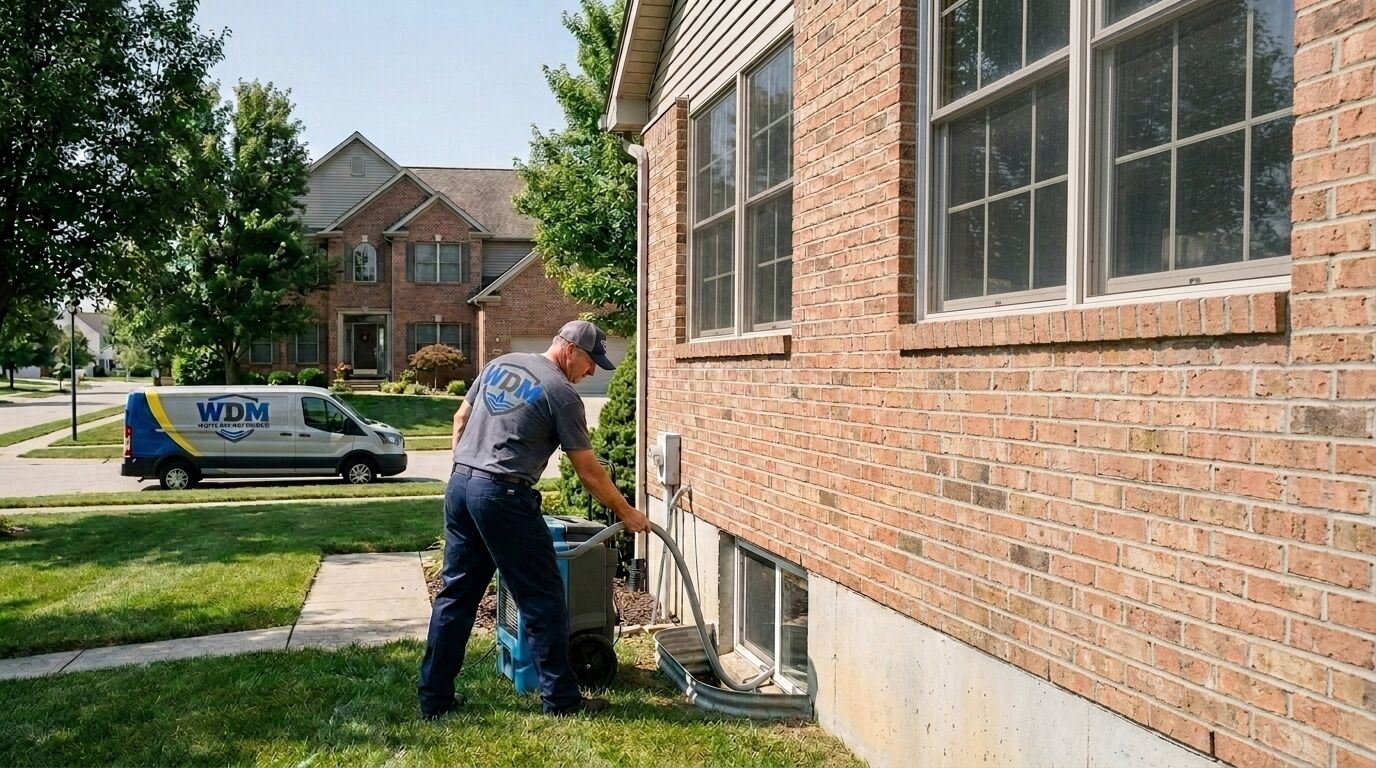
What flood cleanup involves
The sequence starts with removal of standing water, then removal of porous material that absorbed it. Flood damage restoration is often described as drying, but on an external-water event a large share of the work is deciding correctly what cannot be saved. Pad under carpet, particleboard, and saturated insulation rarely come back. Hardwood, framing, and block usually can, given enough time and the right equipment.
Typically removed after flooding
- Carpet pad, and often the carpet itself when water was contaminated
- Fiberglass or blown insulation in the wet zone of a wall
- Particleboard cabinet bases, shelving, and furniture legs sitting in water
- Cardboard storage and anything porous that spent hours submerged
What flooding looks like around Muncie
Most flooding calls here follow the same pattern rather than a river event: a long, heavy spring or summer storm saturates already wet ground, water finds the low side of your home, and it comes in through a window well, an areaway, or the joint where a block wall meets the basement floor. On rental property the discovery is often delayed, because nobody is in the lower level until a tenant goes down for laundry and finds it.
Properties near the White River corridor and low-lying lots elsewhere in Delaware County see this more often, though the deciding factor is usually grade and drainage at your individual home rather than the address itself.
What to do before help arrives
- Do not stand in flood water where power is on, and do not use an outlet or appliance that has been submerged.
- Stay out entirely if the water may involve a sewer backup, and treat any odor as a reason to keep people and pets out.
- If it is safe and outside the water, move belongings up rather than out through the wet area, and photograph the level before anything shifts.
Our approach
Sorting salvage from loss before drying starts
Make the area safe
Power to the affected zone is addressed first, then access. Contaminated water changes the protective measures and the disposal path.
Extract and strip out
Water comes out, then unsalvageable porous material is removed and bagged so it is not carried back through clean areas of the building.
Clean, then dry
Surfaces that stay get cleaned before equipment goes in, because drying a dirty surface locks the residue in place. Readings then run until the structure holds dry.
Water came in during the storm?
The sooner it comes out, the more of the finished space survives it.
Questions after a flood
The water already drained away. Is there still anything to do?
Usually yes. Once the visible water leaves, what remains is inside the slab, the base of the walls, and anything porous it touched. That moisture is what causes odor and growth later. A reading takes minutes and tells you whether the structure actually dried or just looks dry.
Can I keep the carpet if it dried out?
It depends on what the water was. Clean rain that entered a finished area and was extracted quickly sometimes allows carpet to be saved with the pad replaced. Water that crossed soil, a driveway, or a floor drain is treated as unsanitary, and the usual outcome is removal.
What causes water to come back into the same spot?
Almost always grade, drainage, or a pump. Downspouts discharging next to the foundation, a window well without drainage, ground that slopes back toward the house, or a single sump pump with no backup all produce a repeating event. Cleanup fixes the damage; those items are what stop the repeat.