Muncie, Indiana
Water Damage Repair and Mitigation in Muncie
This page explains the mitigation sequence itself: what gets checked, in what order materials are dried, and what evidence exists at the end. If water is moving through the building as you read this, call first and read later.
Mitigation comes before repair
Water damage work splits into two halves that often get confused. Mitigation is the emergency half: stopping the spread, removing water, and drying the structure so damage stops growing. Repair is the rebuilding half: replacing drywall, flooring, trim, and paint. Doing the second before the first is finished is how a home ends up with new flooring laid over a subfloor that never dried.
What the mitigation work involves
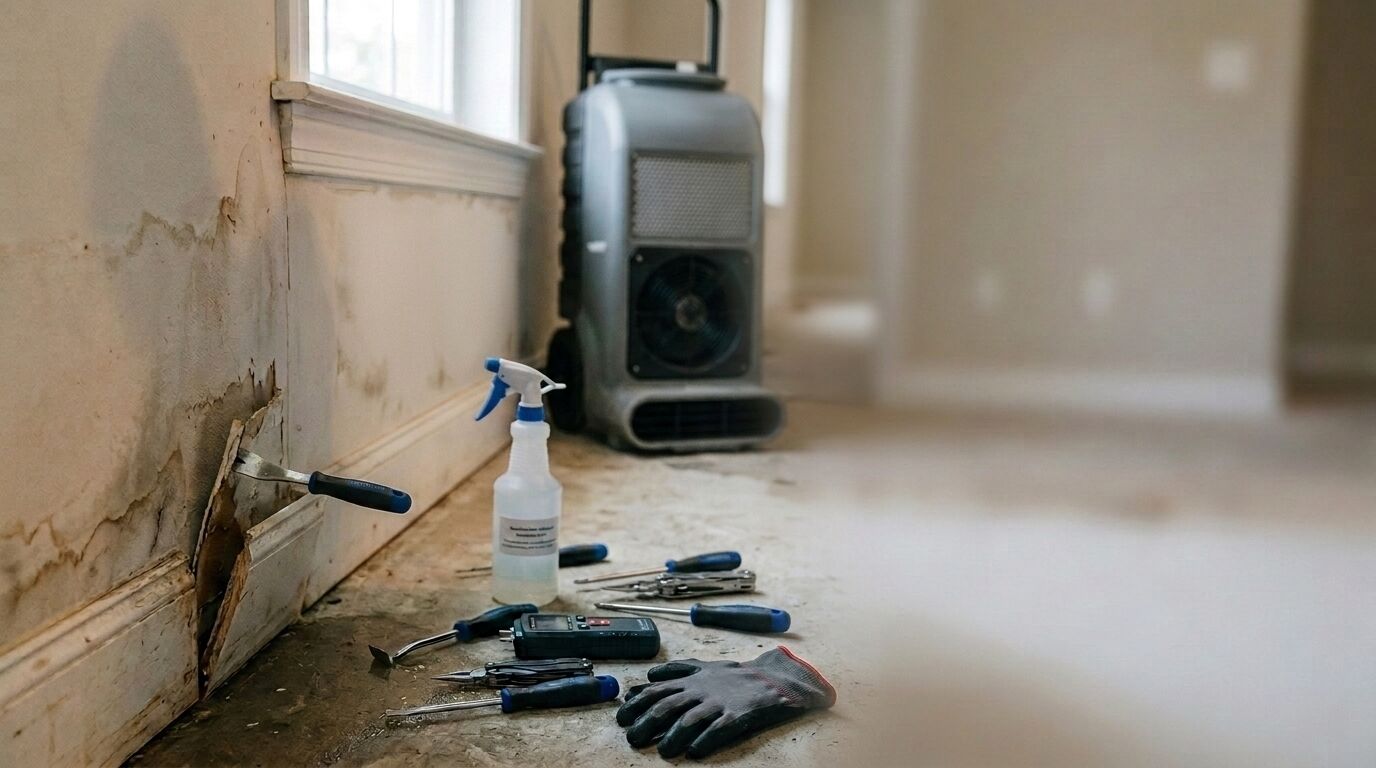
The first pass is diagnostic. We trace how far the water traveled, which is almost always farther than the visible edge, and identify the category of water so contaminated material is handled differently from clean supply water. Readings are taken in structure and contents before equipment goes in, because a drying job without a starting number cannot be proven finished.
What gets checked in your Muncie home
- Subfloor and floor structure below any wet finished floor
- The lower few inches of drywall and any insulation behind it
- Wall cavities on both sides of a shared wall in a duplex or converted house
- Basement stairs, storage areas, and anything sitting directly on a slab
- Mechanical spaces where a furnace, water heater, or panel sits low
What this looks like on rental property in Muncie
On a managed property, the mitigation record does double duty. It tells the drying crew when the job is finished, and it tells an owner or adjuster what was found before anything was torn out. That matters on multi-unit buildings around Muncie, where a supply line failure upstairs frequently becomes a ceiling problem downstairs and the two units may be insured, occupied, and billed differently.
It also matters on older single-family stock. When drywall is opened in a house built decades ago, what is found behind it is sometimes older damage from a previous event. Documenting the difference protects everyone in the conversation that follows.
What to do before help arrives
- Keep clear of any wet area where outlets, cords, or a panel are involved, and do not restore power to a circuit that has been wet.
- If the source is a supply line and the shutoff is safe to reach, close it. Otherwise leave it and say so on the call.
- Lift what you can move: rugs, boxes, and anything on the floor of a finished space. Take photos before you move things.
Our approach
Drying that is measured, not assumed
Map the affected area
Readings and inspection establish how far water moved through the structure, including cavities and materials that look untouched from the room side.
Remove what cannot be dried
Saturated pad, contaminated material, and anything holding water that equipment cannot reach comes out. What can be dried in place stays.
Dry to a standard and record it
Air movers and dehumidifiers run against daily readings until values hold steady. The log of those readings is the proof the building is dry, and it goes with the job.
Want to know what stage you are at?
Describe what has already been done and we will tell you what is still outstanding.
Questions about repair and mitigation
Do you handle the rebuild after drying?
Mitigation is the work described on this page: extraction, drying, removal of unsalvageable material, and documentation. Rebuild work such as drywall, flooring, and paint is a separate stage. Ask on the call and we will tell you what we cover directly and where a repair trade takes over.
How do you check for water inside walls and under flooring?
Meters read moisture in materials rather than on the surface, and readings are compared against an unaffected area of the same material. Where a cavity cannot be read reliably, a small inspection opening is made in a low, easily repaired location rather than guessing.
What happens if the water sat for a day or more?
Longer contact means more material absorbs water and the risk profile changes, including microbial growth. The approach shifts toward removing saturated porous material rather than trying to dry it in place. That is a judgment made from readings and conditions in your home, not from the clock alone.